Vape liquid storage for home mixers, ingredient by ingredient
A litre of base, a drawer of half used concentrates, a few nicotine shots kept apart and several bottles resting in the dark. Anyone who mixes at home keeps products that do not age at the same pace, while most retailer guides are written around a single ready made bottle. Good vape liquid storage on a DIY bench therefore needs a method ingredient by ingredient, built on figures whose sources do not always agree.
Vape liquid storage for home mixers, the short answer
Four habits cover most of vape liquid storage at home. Bottles stay capped and upright in a dark cupboard, away from radiators and sunny windowsills. The air inside each bottle is kept to a minimum, even if that means decanting into something smaller.
Every ingredient keeps its own date, and a finished mix takes the date of whichever component expires first. Anything containing nicotine goes into a closed box of its own, out of reach of children and pets. UK rules require nicotine products, or their packaging, to be child resistant and tamper evident, so that cap is worth closing properly every time.
Light, heat, air and moisture, what actually spoils a mix
DarkStar, a British supplier of DIY bases and concentrates, groups storage into five basics, and four of them are physical. Light and air hit the nicotine hardest, heat speeds everything up and moisture works on the base itself.
Ultraviolet light breaks nicotine down and can affect some flavour compounds. That is why serious suppliers sell bases in opaque containers and concentrates in tinted glass, and why a clear bottle on a bright shelf loses quality long before its date.
Heat speeds up every reaction in the bottle. A shelf above a radiator, a car in July or a cupboard next to the oven shortens the life of a mix, and the liquid darkens sooner than it should.
Oxygen gets in every time a cap comes off and fills whatever space is left. The same supplier calls it the main cause of nicotine degradation, which makes half empty bottles and opened litre containers the weak point of any bench.
Moisture is the factor most guides mention only in passing. PG and VG both absorb water from the air, so a cap left loose overnight lets a base take on humidity as well as oxygen.
Base, concentrates, nicotine shots and finished mixes
Published timings rarely cover the same product, and they only become useful for vape liquid storage once they are separated. The figures below come from the supplier quoted above, and the date printed on each bottle always has the final word.
| Ingredient | Indicative shelf life |
|---|---|
| PG and VG base without nicotine | 2 to 3 years |
| Flavour concentrates | 2 to 3 years |
| Nicotine, refrigerated or frozen | 1 to 2 years, 3 years or more frozen |
| Finished mix without nicotine | 2 years or more |
| Finished mix with nicotine | 1 to 2 years |
The PG and VG base
Propylene glycol and vegetable glycerine are the sturdiest ingredients on the bench. A nicotine free base needs little more than a cool cupboard and a tight cap, whereas a base containing nicotine follows the rules for shots.
Flavour concentrates
Concentrates are opened at every session, drop by drop, so each bottle meets the air far more often than a base does. Write the opening date and the batch number on each one, so that a recipe that worked can be traced back to the exact bottle. The same supplier notes that concentrates vary and invites buyers to check individual products.
Nicotine shots
In the UK a nicotine shot is a 10 ml bottle at no more than 20 mg/ml, the legal ceilings for any refill container that holds nicotine. It is also the ingredient to protect first. The supplier quoted above keeps its own nicotine at -18 °C and says freezing dramatically slows oxidation, with refrigeration close behind. The arithmetic of adding shots to a shortfill is covered in our guide to nicotine shot dosage.
Finished mixes
A bottle mixed at home lasts roughly one to two years with nicotine and two years or more without. For anything meant to wait, the same supplier suggests mixing at zero and adding the nicotine later. In every case the useful date is the earliest one among the ingredients that went in.
Vape liquid storage temperatures, and why the figures disagree
Ideal temperature is where storage guides contradict each other most.
One UK retailer recommends room temperature between 15 and 25 °C. Vapeology gives 15 to 20 °C in an April 2025 post, attributing the range to general chemical storage guidance, after advising 20 to 22 °C in an earlier post on the same blog in February 2025. One retailer, two ranges, two months apart.
The gap matters less than it seems. Every source keeps the upper limit around room temperature and warns against heat, while the lower limit depends on whether a bottle is in use or set aside for months.
Cold has a catch of its own. A bottle taken out of the fridge should come back to room temperature before it is opened, otherwise condensation can form inside the bottle.
Bottles and headspace, decant rather than open a big container
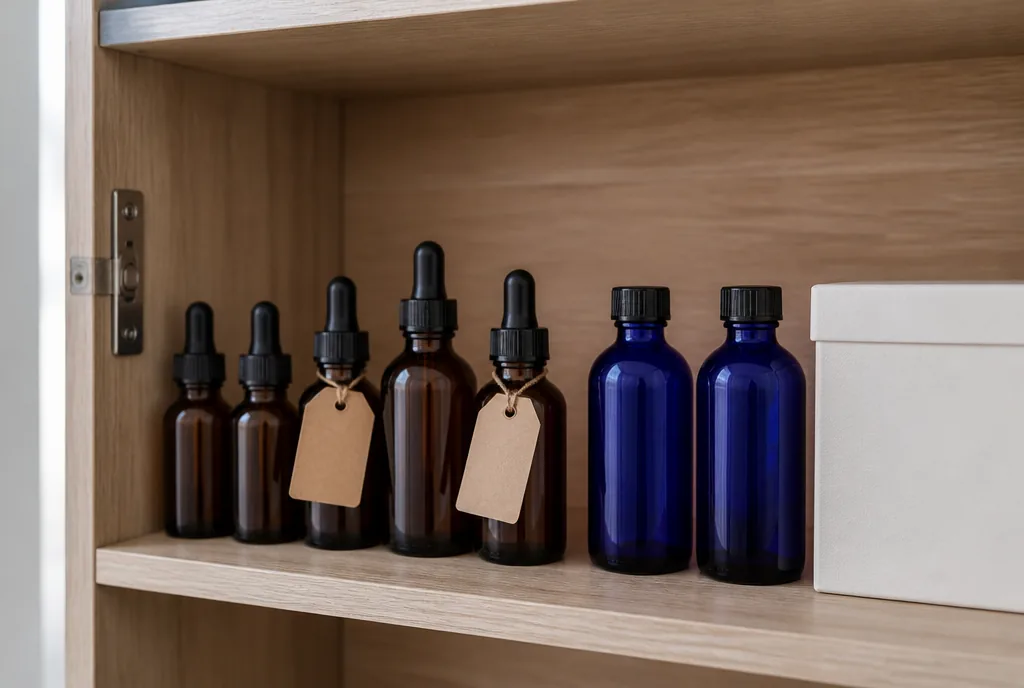
Tinted glass filters part of the light, and amber glass is a common retail recommendation for long storage. Glass has a second advantage, since it does not react with what it holds.
Citrus and cinnamon recipes have an extra reason to move to glass, since the supplier quoted above warns that those flavours can interact with plastic.
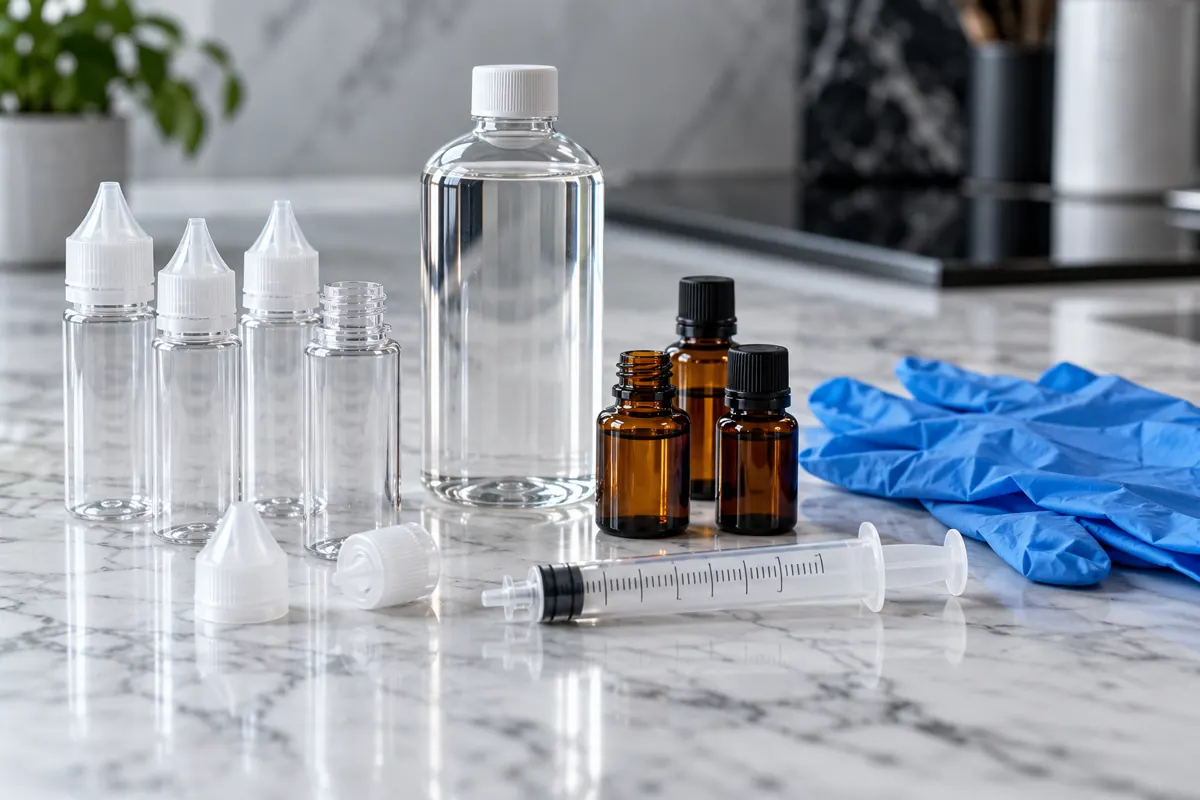
The real lever is headspace. A litre of base goes into smaller bottles opened one at a time, so the rest never sees the air. With plastic bottles, squeezing out the excess air before capping does the same job on a smaller scale. For a finished mix, a small bottle filled to the neck beats a large one left two thirds empty.
Labelling every mix, date, recipe and nicotine strength
On a home mix the minimum is four pieces of information, the date it was made, the recipe (PG VG ratio and flavour percentage), the nicotine strength and the earliest expiry date among the ingredients.
Stick the label on at the moment of mixing, straight after shaking, the last stage of our complete method to make your own e-liquid.
Storage and steeping, two stages not to confuse
Steeping is a deliberate rest, from a few days to a few weeks, while the flavour settles into the base. Storing a home mix starts afterwards, once the taste has found its balance and the job is to keep it there.
During steeping you open and taste at intervals. Once the recipe has matured, every opening lets air in and brings the end date closer. Rest times by flavour family are set out in our guide to steeping e-liquid.
FAQ
Five questions come up again and again among people who keep their ingredients for months.
Can you freeze a home made e-liquid?
Yes. Base and most mixes can go in the freezer, where they turn thick and syrupy without setting solid. Freezing in small bottles means only the volume you need comes out, while the rest stays cold.
Is a concentrate past its date unusable?
Not necessarily. The date marks the end of the period during which the maker expects the flavour to perform fully. After it the note may fade, which a quick sniff usually reveals before the concentrate goes into a large batch.
Why does my base look thicker in winter?
Vegetable glycerine becomes more viscous as the temperature drops, so a VG heavy base draws less easily into a syringe. A few hours in a heated room restores its flow without any direct heat.
Is the kitchen fridge a good place?
It works, but the bottles should never sit among food. Keep them in a closed, labelled box on a dedicated shelf so that nobody mistakes them for anything else.
Does a shortfill keep differently once the shot is in?
In practice, yes. A sealed shortfill holds no nicotine, so it behaves like a nicotine free mix until the shot goes in. From then on it is a nicotine mix with the shorter timings that go with it, and the day you added the shot is the date to write on the bottle.
Vape liquid storage that keeps your recipes worth repeating
Good storage depends less on one figure than on organisation. Each ingredient has its own lifespan, from the sturdy PG VG base to fragile nicotine, and the air left in a bottle matters as much as the temperature around it.
In the end, sound vape liquid storage means keeping ingredients separate for as long as possible, cutting the headspace in every bottle, choosing a dark cupboard at or below room temperature and dating every bottle. Home mixing gets more consistent with every stage brought under control, from dosing and steeping through to the shelf.
Editorial content for adult readers only. Nicotine is an addictive substance, and nicotine vaping products are not for sale to anyone under 18 in the UK. This article is not a buying recommendation.